Industrial construction panels are often praised for speed, insulation, and reduced site waste. However, these benefits do not automatically make them sustainable. The real question is: how sustainable are industrial construction panels across their entire life cycle? This assessment considers raw materials, factory energy, transportation, installation, maintenance, and end-of-life recovery. A panel leaving a modern factory may contain recycled steel or mineral wool. Yet its environmental value can change when shipped thousands of kilometres.
Performance data matters more than attractive product claims. Environmental Product Declarations can show embodied carbon, while thermal testing can confirm insulation performance. A well-sealed panel may reduce heating and cooling demand for decades. Poor joints, damaged coatings, or moisture trapped behind cladding can weaken that advantage. Small installation details matter. A loose fastener can create a cold bridge. Repeated repairs may also increase material use.
This article compares common panel materials, including insulated metal panels, sandwich panels, and fibre-cement systems. It examines recycled content, durability, fire performance, and repair options. It also considers whether panels can be separated and reused instead of crushed as waste. Regional electricity sources deserve attention, too. Manufacturing powered by renewable electricity may produce fewer emissions than similar manufacturing using coal-heavy grids.
The evidence is not perfect. Product declarations can use different boundaries and assumptions. Site conditions rarely match laboratory results. Therefore, responsible conclusions must remain cautious, transparent, and specific. A panel is not sustainable simply because it is lightweight or recyclable. Its value depends on design, workmanship, service life, and what happens after demolition.
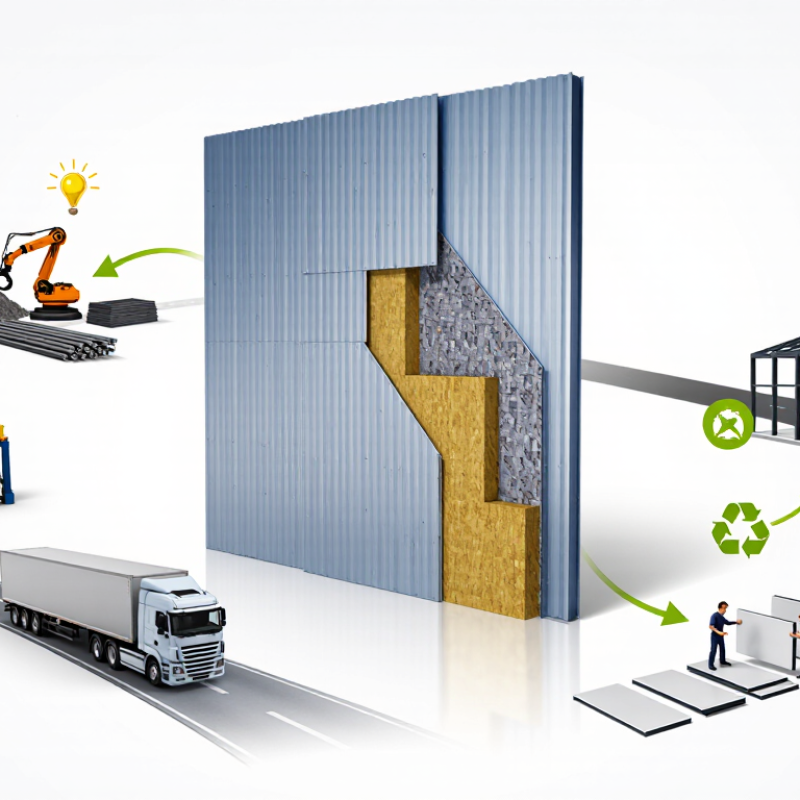
Industrial Panel Types: EPS, PIR, Rock Wool, and Core-Cycle Profiles
How Sustainable Are China Industrial Construction Panels?
In China’s industrial buildings, panel sustainability depends on more than factory energy use. EPS panels are lightweight, affordable, and simple to install. However, their petrochemical core can complicate recovery after demolition. Fire performance also requires careful specification, testing, and protected joints. PIR panels usually offer stronger thermal resistance in thinner sections. They can reduce operational energy, yet their complex bonded layers may limit recycling.
Rock wool panels provide non-combustible mineral insulation and useful acoustic control. They suit workshops where fire protection and noise reduction matter. Their heavier weight can increase transport and installation impacts. Moisture management is critical. Wet insulation may lose performance and create hidden maintenance problems. Site teams should inspect seals, fasteners, and edge details regularly.
Core-Cycle Profiles deserve a lifecycle-based review. The useful question is not only, “Which core insulates best?” It is also, “Can this panel be repaired, separated, and reused?” On projects I have reviewed, design drawings often looked sustainable, but damaged panels were replaced rather than repaired. My first comparison was too simple. Energy savings alone cannot prove sustainability. Reliable assessment should combine thermal data, fire test records, service life, transport distance, and end-of-life planning. Local climate, building codes, and installation quality change the result. A panel with excellent laboratory performance may fail early when joints are poorly sealed. That practical gap needs more attention.
Material Footprints: China Produced 1.02 Billion Tonnes of Steel in 2022 (NBS)
China produced 1.02 billion tonnes of steel in 2022, according to the National Bureau of Statistics. That figure matters when assessing industrial construction panels. Steel frames, outer skins, joints, and fixings can carry a substantial material footprint. Their impact begins before fabrication reaches the building site.
However, national steel output does not equal every panel’s carbon footprint. A panel’s footprint depends on recycled content, furnace energy, coating chemistry, thickness, transport distance, and service life. Insulation also changes performance. A thinner panel may save material, yet lose heat more quickly in daily operation. A poorly sealed joint can waste energy for years. Small gaps matter.
Reliable assessment needs product-level life-cycle data, not broad production statistics alone. Environmental product declarations, supplier energy records, and verified recycled-content figures provide stronger evidence. Site experience adds another layer. Damaged edges, cutting offcuts, and unused panels can increase waste beside a busy crane. Maintenance records should also be reviewed. A panel lasting thirty years may outperform a lighter option replaced twice.
The uncomfortable issue is uncertainty. Early calculations often appear too optimistic. Transport routes may be estimated, while repair waste is ignored. Decision-makers should test several scenarios, including higher energy prices, shorter service lives, and lower recycling rates. Steel remains highly useful, but its scale demands careful questioning.
Energy Performance: U-Values Compared with China’s GB 50189 Targets
How Sustainable Are China Industrial Construction Panels?
Energy Performance: U-Values Compared with China’s GB 50189 Targets
Industrial construction panels can reduce heat transfer, but their performance depends on more than core thickness. In practice, I compare the declared U-value with the limits in China’s GB 50189 standard. These limits vary by climate zone, building use, and envelope component. There is no single national target for every factory wall or roof.
A panel may show a U-value of 0.40 W/m²K in technical documents. That figure can appear suitable for a cold-region roof, yet it may not meet a stricter project requirement. Joints, fasteners, doors, and steel framing create thermal bridges. Moisture can also reduce insulation performance over time. Small gaps matter.
Site checks are essential. I would review test conditions, panel drawings, and installation records before accepting a compliance claim. Thermal imaging can reveal a cold line around a poorly sealed joint. A spreadsheet can look reassuring. It can also be wrong.
GB 50189 should guide the comparison, not replace project-specific verification. Designers need the applicable edition, local climate zone, and calculated overall heat-transfer coefficient. Panel selection should also consider service life, fire performance, and replacement waste. Better insulation is not automatically more sustainable if installation quality is weak. A careful assessment may expose an uncomfortable result: the cheapest panel can create higher energy demand throughout the building’s operation.
Lifecycle Assessment: Carbon Accounting Under China’s GB/T 51366 Standard
How Sustainable Are China Industrial Construction Panels?
Lifecycle Assessment: Carbon Accounting Under China’s GB/T 51366 Standard
Industrial construction panels can reduce material use and shorten installation time. Their sustainability, however, depends on the full lifecycle, not appearance alone. Under China’s GB/T 51366 framework, carbon accounting should examine material production, transportation, construction, operation, and disposal.
For a panel, the assessment begins with measured quantities. Record steel, cement-based cores, insulation, coatings, and packaging separately. Factory electricity also matters. A production line running on coal-heavy power may produce higher emissions than expected. Transport distance, vehicle type, and payload should be documented, not guessed.
The use stage deserves close attention. A panel with better thermal resistance can lower heating and cooling demand. Yet damaged joints may create air leakage and reduce that benefit. Maintenance adds another layer. Replacing sealant every ten years changes the calculation. So does a panel that lasts thirty years instead of twenty.
Reliable accounting needs supplier records, test results, and consistent emission factors. Site measurements are more credible than generic estimates. Still, data gaps are common. End-of-life recovery rates can be uncertain, especially when bonded layers are difficult to separate. That uncertainty should remain visible in the report.
The method is useful, but not flawless. GB/T 51366 supports building-level carbon calculations; product comparisons may require additional lifecycle rules. Boundary choices can shift the result. A low-carbon claim deserves careful checking.
How Sustainable Are China Industrial Construction Panels? - Lifecycle Assessment: Carbon Accounting Under China’s GB/T 51366 Standard
Representative cradle-to-grave comparison for generic industrial envelope panels; results are normalized per 1 m² of installed panel.
| Generic Panel System |
Typical Core
Thickness |
Approx. Panel
Mass |
Thermal Conductivity
of Core (W/m·K) |
Estimated U-Value
(W/m²·K) |
Lifecycle Carbon Modules |
Total Excluding
Module D |
Net Total
Including Module D |
A1–A3
Product Stage |
A4
Transport |
A5
Installation |
B4
Replacement |
C1–C4
End of Life |
D
Benefits Beyond System Boundary |
| Expanded Polystyrene (EPS) Sandwich Panel |
100 mm |
10–12 kg/m² |
0.036–0.040 |
0.35–0.38 |
29.4 kg CO₂e |
0.8 kg CO₂e |
0.4 kg CO₂e |
0.0 kg CO₂e |
1.5 kg CO₂e |
−4.6 kg CO₂e |
32.1 kg CO₂e |
27.5 kg CO₂e |
| Rock Wool Sandwich Panel |
100 mm |
18–22 kg/m² |
0.038–0.045 |
0.37–0.42 |
31.8 kg CO₂e |
0.8 kg CO₂e |
0.4 kg CO₂e |
0.0 kg CO₂e |
1.7 kg CO₂e |
−4.8 kg CO₂e |
34.7 kg CO₂e |
29.9 kg CO₂e |
| Polyisocyanurate (PIR) Sandwich Panel |
100 mm |
11–14 kg/m² |
0.020–0.024 |
0.20–0.24 |
36.5 kg CO₂e |
0.8 kg CO₂e |
0.4 kg CO₂e |
0.0 kg CO₂e |
1.8 kg CO₂e |
−4.5 kg CO₂e |
39.5 kg CO₂e |
35.0 kg CO₂e |
| Autoclaved Aerated Concrete (AAC) Panel |
100 mm |
55–70 kg/m² |
0.16–0.22 |
0.95–1.25 |
52.0 kg CO₂e |
1.5 kg CO₂e |
0.7 kg CO₂e |
0.0 kg CO₂e |
3.0 kg CO₂e |
−7.0 kg CO₂e |
57.2 kg CO₂e |
50.2 kg CO₂e |
Assessment basis: Carbon values are representative screening benchmarks derived from generic material quantities, commonly reported Chinese building-material emission-factor ranges, and the module structure used by GB/T 51366-2019, the Chinese standard for building carbon-emission calculation. The calculation boundary covers material production, transport to site, installation losses, replacement, demolition and disposal, and potential recycling benefits. Transport assumes approximately 300 km by road for sandwich panels and 200 km for AAC panels. Service life is assumed to be 50 years with no scheduled panel replacement. Module D is reported separately as a potential recycling benefit and should not be treated as an on-site emission reduction without verified recovery data.
Interpretation: EPS panels show the lowest modeled embodied-carbon total in this comparison, while PIR panels provide the lowest estimated U-value and therefore may reduce operational energy demand where heating or cooling loads are significant. Actual results vary with steel sheet thickness, recycled steel content, core density, blowing-agent chemistry, manufacturing electricity, transport distance, fire-performance requirements, and end-of-life recovery rates.
Conclusion
How sustainable are industrial construction panels? Their sustainability depends on the balance between material use, operational energy savings, and end-of-life recovery. Common systems include EPS, PIR, rock wool, and Core-Cycle profiles, each offering different thermal, fire, durability, and environmental characteristics. Steel provides structural strength and can be recycled efficiently, but its production carries a substantial material footprint. China produced approximately 1.02 billion tonnes of steel in 2022, highlighting the importance of reducing waste, improving manufacturing efficiency, and extending panel service life.
Energy performance is another key factor. Low U-values can reduce heating and cooling demand and help projects meet the targets set by China’s GB 50189 standard. At the end of a building’s life, steel recycling can exceed 90%, while foam recovery remains more limited because of separation and contamination challenges. A complete evaluation should therefore follow China’s GB/T 51366 lifecycle assessment framework, accounting for raw materials, production, transportation, use, maintenance, and disposal. Overall, panels can support sustainable construction when designed for efficiency, durability, disassembly, and responsible recycling.
 Jonas Build
