Why Are Insulated Panels From China Becoming More Popular?
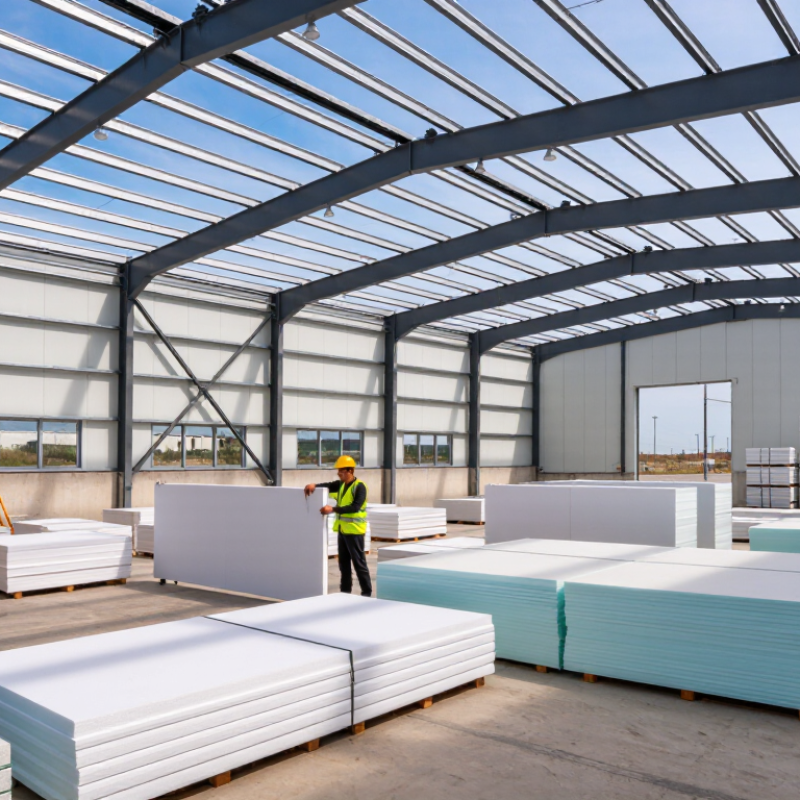
Across warehouses, cold-storage facilities, and modular buildings, insulated panels from China are becoming increasingly visible. Factory production can deliver consistent thickness, pre-cut joints, and faster installation. A 100-millimeter PIR panel may arrive ready for assembly, reducing wet trades and shortening construction schedules. This practical advantage matters when labor costs rise or projects face tight deadlines.
So, why are insulated panels becoming more popular? The answer involves energy efficiency, prefabrication, and competitive manufacturing capacity. Chinese manufacturers produce panels using PIR, EPS, rock wool, and other core materials. They also offer varied surface coatings, dimensions, and connection systems. Joseph Lstiburek, a widely respected building-science expert, stated, “The perfect wall is a wall that has all the control layers on the exterior of the structure.” Insulated panels can support this principle by combining thermal control and weather protection in one factory-made component.
However, popularity should not be confused with automatic suitability. Product quality varies. Fire performance, moisture resistance, thermal bridging, and certification require careful verification. A low price can become expensive if joints leak or coatings fail early. Project teams should review test reports, installation instructions, factory experience, and local building requirements. Samples also deserve physical inspection, not only digital approval.
The market is moving quickly. That does not make every panel a wise choice. This article examines the real reasons behind the trend, while questioning its limitations, overlooked risks, and long-term value.
Why Are Insulated Panels From China Becoming More Popular?
Market Overview of Insulated Panels From China
China’s insulated panel market has expanded across cold storage, factories, warehouses, agricultural buildings, and temporary facilities. Demand is linked to faster construction and stricter energy-efficiency expectations. Manufacturers commonly offer panels with mineral wool, polyurethane, or PIR cores. Each core changes fire performance, thermal resistance, weight, and cost. That choice matters. In practice, buyers compare more than the quoted price.
A credible market review examines production capacity, export experience, certifications, and quality-control records. Panel thickness, joint design, coating, density, and dimensional tolerance affect installation. For example, a poorly aligned joint can create a visible thermal bridge around a warehouse door. Experienced buyers request test reports, sample panels, and factory inspection evidence before signing. They also check whether documents match the exact core and thickness ordered. Small detail, major risk.
China’s advantage often comes from broad supply networks, flexible customization, and competitive manufacturing costs. However, quality is not uniform across the market. Some quotations exclude packaging, testing, inland transport, or installation accessories. Delivery time may change when raw-material prices rise or export schedules tighten. I would not treat a low price as proof of efficiency. It may reflect thinner steel, weaker joints, or limited inspection. A careful procurement process combines technical review with independent verification. That approach is slower, but usually more reliable.
| Market Dimension | Insulated Panel Data or Typical Range | Why It Matters in the China Supply Market | Application Relevance | Reference or Data Basis |
|---|---|---|---|---|
| Common Core Materials | Expanded polystyrene (EPS), polyurethane (PUR), polyisocyanurate (PIR), rock wool, and glass wool are the main commercial core materials. | A broad domestic manufacturing base allows buyers to compare thermal, fire, cost, and weight requirements within one sourcing market. | EPS is commonly selected for cost-sensitive buildings; PIR and PUR for high thermal performance; mineral wool for stronger fire-performance needs. | Product classifications commonly used in European and international insulated-panel standards. |
| Typical Panel Thickness | Approximately 30–250 mm | Chinese manufacturers generally offer multiple thickness options and can produce non-standard thicknesses for project specifications. | Thin panels are used for partitions and moderate climates; thicker panels are used for cold storage, warehouses, and energy-efficient envelopes. | Typical commercial product range; exact limits depend on the core, profile, joint design, and manufacturing line. |
| Common Effective Width | Approximately 950–1,200 mm | Standardized widths support faster installation and simplify container loading, handling, and project quantity calculations. | Suitable for wall, roof, ceiling, cold-room, and modular-building systems. | Typical industry range; actual effective width varies by joint and panel profile. |
| Panel Length | Usually project-specific; commonly up to about 12 m for transportable units | Cut-to-length production can reduce on-site joints and material waste, while transport limits remain an important design consideration. | Long panels are useful for warehouses, agricultural buildings, factories, and prefabricated structures. | Practical manufacturing and logistics range; maximum length depends on equipment, loading method, road transport, and destination regulations. |
| Thermal Conductivity of Core |
EPS: about 0.035–0.040 W/m·K PUR/PIR: about 0.020–0.028 W/m·K Mineral wool: about 0.035–0.045 W/m·K |
Lower conductivity means that a thinner panel can achieve a similar insulation target, which can reduce envelope thickness and usable-space loss. | PIR and PUR are often preferred where insulation performance and limited wall thickness are priorities. | Typical declared ranges from commonly used insulation-material data; final design values must use the supplier’s tested declaration. |
| Approximate Core Density |
EPS: about 12–25 kg/m³ PUR/PIR: about 35–45 kg/m³ Mineral wool: about 80–150 kg/m³ |
Lower-density cores can reduce handling and structural loads, while denser mineral-wool cores generally provide greater mass and fire resistance. | Density selection affects lifting, fixing systems, acoustic behavior, impact resistance, and supporting-structure design. | Typical commercial ranges; density should be verified against the product test report. |
| External Steel Skin | Commonly about 0.40–0.80 mm coated steel | A wide selection of steel thicknesses and coatings enables cost adjustment according to structural, corrosion, and appearance requirements. | Thicker skins are generally selected for high-wind areas, impact exposure, roof traffic, or increased fastening requirements. | Typical market range; coating type, yield strength, and corrosion category should be specified separately. |
| Typical Thermal Transmittance Target | Approximately 0.15–0.70 W/m²·K, depending on core material, thickness, joints, and thermal bridges | Panel thickness can be matched to the energy code and climate zone of the destination market rather than using one universal specification. | Relevant to warehouses, logistics centers, food-processing facilities, cleanrooms, offices, and refrigerated buildings. | Illustrative design range. Whole-assembly U-value must be calculated, including joints, fasteners, framing, and openings. |
| Fire-Performance Consideration | Mineral-wool systems can achieve non-combustible classifications in tested assemblies; EPS, PUR, and PIR performance varies by formulation, facings, joints, and complete assembly. | Buyers increasingly request fire-test documentation instead of relying only on the core-material name or a generic product description. | Particularly important for public buildings, factories, high-bay warehouses, cold stores, and projects with strict insurance requirements. | Classification must be based on the applicable test standard, such as EN 13501-1, ASTM E84, ASTM E119, or local building regulations. |
| Moisture and Corrosion Requirements | Key variables include closed-cell structure, vapor control, joint sealing, steel coating, salt exposure, and condensation risk. | Export-oriented production can be adapted to humid, coastal, cold, or high-temperature environments when the specification is clearly defined. | Essential for refrigerated rooms, coastal warehouses, food plants, agricultural buildings, and projects exposed to high humidity. | Performance depends on the complete envelope design rather than the panel core alone. |
| Main Export-Driven Value Factors | High production capacity, extensive raw-material supply chains, flexible customization, competitive labor and manufacturing costs, and established container-export infrastructure. | These factors can reduce procurement cost and shorten the time required to source panels, accessories, profiles, and installation components together. | Most relevant to large-volume projects and buyers seeking private-label, custom-color, custom-joint, or project-specific production. | Market-structure assessment based on China’s large manufacturing and export ecosystem; actual savings depend on specifications and logistics. |
| Global Demand Driver | Buildings account for approximately 30% of global final energy use, while building operations and construction together represent a major share of energy-related emissions. | Energy-efficiency requirements are increasing interest in insulated building envelopes and prefabricated construction systems. | Supports demand for insulated panels in industrial, commercial, residential, logistics, and temperature-controlled facilities. | International Energy Agency, “Buildings” sector analysis and global building-sector energy data. |
| China Construction Context | China’s urbanization rate reached approximately 66.16% at the end of 2023. | Continued urban development, industrial expansion, logistics construction, and renovation create a substantial domestic manufacturing base for insulated-envelope products. | Supports production scale for industrial buildings, modular facilities, warehouses, and energy-saving renovation projects. | National Bureau of Statistics of China, 2023 national economic and social development data. |
| Important Buyer Documents | Product datasheet, core-density declaration, thermal-conductivity data, fire-test report, steel-coating specification, dimensional tolerance, installation manual, and quality-inspection records. | Documentation helps buyers compare suppliers on verified performance rather than price, appearance, or nominal thickness alone. | Required for technical approval, building-permit submissions, insurance review, and quality control at the construction site. | Recommended procurement checklist; project-specific certifications may be required by the destination country. |
| Total Delivered-Cost Factors | Panel price, accessories, packaging, inland transport, ocean freight, insurance, import duty, customs fees, unloading, installation, and waste. | A lower factory price does not always produce the lowest project cost; joint compatibility, packaging quality, shipping efficiency, and documents can materially affect the final landed cost. | Especially important for long-distance orders and projects requiring multiple panel thicknesses or special profiles. | Standard international procurement and landed-cost calculation principles. |
They combine factory production, practical insulation, flexible dimensions, and large supply capacity. Production can be scaled for warehouses, cold rooms, and modular buildings. That helps.
Factory-made panels may reduce on-site labor, material waste, and installation time. The lowest purchase price is not always the lowest project cost. Details matter.
Common applications include cold storage, food processing, warehouses, modular buildings, and controlled industrial spaces. A cold-room wall may need stronger moisture control than a dry warehouse wall.
Mineral wool, PIR, and EPS provide different thermal, fire, moisture, and acoustic properties. The correct choice depends on building use, climate, and local requirements. There is no universal winner.
Request tested U-values, core density, fire classification, joint details, coating durability, and installation tolerances. Independent test data and clear production records can reveal weak points before shipping.
Better wall and roof envelopes can reduce heating and cooling loads. However, a small gap near a fastener or cold-room door can cause heat loss and condensation. That hurts.
Crews should check joints, fasteners, door edges, and panel alignment during installation. Rushed work may leave gaps that later require costly repairs. The details are easy to miss.
Review factory quality controls, sample panels, test reports, certifications, and technical communication. Confirm dimensions, packaging, shipping arrangements, and site supervision requirements. A document alone cannot guarantee field performance.
Insulated panels from China are gaining attention in the global construction market because they combine efficient thermal performance, flexible design, and competitive pricing. Made with materials such as steel skins, polyurethane, polyisocyanurate, rock wool, or expanded polystyrene cores, these panels are produced through processes that emphasize accurate bonding, continuous shaping, and surface protection. Their lightweight structure helps shorten installation time while supporting energy-efficient building design.
The question “why are insulated panels becoming more popular” can be answered by their broad range of applications, including warehouses, cold storage facilities, commercial buildings, workshops, and modular structures. They offer benefits such as temperature control, fire and sound insulation, durability, and reduced construction labor. However, buyers should carefully review quality certifications, fire ratings, dimensional accuracy, environmental requirements, and shipping costs. Importers should also confirm technical specifications, packaging, documentation, and local building-code compliance before placing an order.

 Jonas Build